Waterproofing Membranes: Make the Test Part of the Assembly
A leak survey cannot rescue an assembly that was never testable. Decide how membrane integrity will be verified before paving, protection or landscaping hides the work.
Specify the decision before the membrane disappears
ASTM D7877-25 covers electrical methods for locating membrane breaches. Its public guidance explains that an electrically conductive return path is needed beneath the membrane; insulating layers can interrupt it. Buying a survey after installation does not establish that the assembly can be tested. [1]
OlbrichCo’s proposed approach starts at design review: decide what evidence will permit a particular area to be covered. Name the approving person, test boundary, selected method, complementary inspections and unresolved conditions that prevent release. This is a construction-quality decision, not a promise that a building will never leak.
Choose the consequential area first: a terrace above occupied rooms, a podium deck or a roof where future access would require removing finishes. Ask the owner what disruption a repair would cause and which interfaces must remain inspectable. Match the investigation effort to that consequence without inventing a universal payback period.
For an Iranian project, confirm that a competent test provider, compatible equipment and approved repair materials can actually be obtained before setting the programme. Allocate attendance, cleaning, protection, retesting and access in the relevant packages. A test allowance with no agreed scope or available operator is not a workable quality plan.
Approve a testable assembly, not just a membrane
Sika’s 2015 technical bulletin warns that overburden composition and thickness can interfere with electronic leak location, and asks designers to preserve compatibility for later investigation. This is manufacturer-specific guidance, not evidence that every covered waterproofing system remains testable. [2]
Require a marked-up section identifying the delivered membrane, adhesive, substrate, insulation, protection layers and proposed testing arrangement. Ask the designer, membrane supplier and testing specialist to resolve compatibility together. Keep their accepted section with the product submittal so a later substitution triggers a new review rather than inheriting an obsolete test plan.
Request an explicit answer for each difficult interface: drains, upstands, movement joints, penetrations and transitions to another system. Record which elements the proposed survey includes and which need a separately approved inspection or test. Avoid a single green mark on the roof plan when its most consequential junctions remain outside the evidence.
Where a supplier proposes an added conductive layer, obtain approval of the complete build-up, including attachment and compatibility, before procurement. Do not improvise a metal mesh or change an adhesive merely to make an instrument respond. The test arrangement must serve the approved waterproofing design, not quietly redesign it.
Prove the selected method on the actual work
ASTM D8231-24a addresses low-voltage electronic scanning of exposed membranes. Its public scope requires verified detection sensitivity and says scanning complements other inspection. The standard is a particular practice, not a generic approval of any instrument carrying an electronic leak-detection label. [3]
Before production testing, agree a representative demonstration with the specialist and witness. Include the actual material combination and a difficult detail where practical. Use an approved test specimen or demonstration arrangement; do not deliberately damage completed waterproofing. Record what the demonstration establishes, what it cannot establish and the conditions required to repeat it.
The specialist’s method statement should identify the equipment, operator competence, calibration checks, surface condition, access needs, coverage and reporting limits. Ask for a sample report before ordering. The designer and manufacturer should confirm the applicable method and acceptance criteria; this article supplies neither electrical settings nor instructions for operating test equipment.
Build the test window around actual site conditions. Agree how dust, construction traffic, surface moisture and weather will be managed, and who decides when conditions invalidate the survey. Use a Persian zone plan and an offline record where necessary, then transfer the approved version to the project register with its date and revision.
Do not turn an unsuitable survey into an unreviewed flood test
ASTM D5957-98(2021) concerns certain horizontal waterproofing installations and explicitly excludes building roofing systems. Its public guidance calls for structural review of test loads. It should not be cited as blanket permission to pond water on any roof when electronic testing is unavailable. [4]
If the selected method cannot produce valid evidence, pause that release and ask the responsible designer for an alternative appropriate to the assembly. Record why the original method failed: access, compatibility, incomplete installation, unsuitable conditions or absent competence. An inconclusive survey is not a passed test, and a changed method needs a changed approval.
Any proposed water test requires a separately reviewed plan for the applicable location, structural capacity, containment, drainage, monitoring and protection of spaces below. Assign authority to stop the test and manage an unexpected ingress event. Do not infer a safe water depth, duration or loading arrangement from a photograph or a generic method name.
Discuss local water availability, permitted disposal arrangements, weather and occupancy with the project team; verify requirements that apply to the particular site. Compare feasible methods on total delivered scope, disruption and repeatability rather than instrument hire alone. No national water-price assumption or claimed percentage saving is needed to make that comparison useful.
Separate a moisture indication from a located breach
WBDG distinguishes membrane-integrity testing from moisture detection. Infrared and capacitance surveys can indicate potentially wet areas without pinpointing a membrane opening; condensation or construction moisture can also complicate interpretation. A moisture map and a located breach answer different questions. [5]
Ask each report to state the question answered, method used, survey conditions, inspected area and exclusions. Use three distinct dispositions: accepted within the agreed scope, requiring corrective action, or inconclusive/not tested. Never let an inaccessible strip disappear from the denominator or become an implied pass through the wording of a summary certificate.
Give each finding a location identifier linked to the current plan, photographs and the responsible package. Require the specialist to distinguish a confirmed breach from an indication needing investigation. Let the designer and approved installer determine the repair; do not authorize indiscriminate coating of the surface simply because a report shows an anomaly.
After repair, repeat the appropriate agreed verification and retain both the original finding and its closure evidence. Ask whether adjoining work or the repair process changed the approved test boundary. Keep unresolved interfaces visible to the release authority, with a named action owner and deadline, instead of declaring the entire deck complete.
Release a mapped zone, then protect the decision
Pilot one bounded zone before repeating the approach across the project. Schedule the inspection and testing while the membrane is accessible, with the installer available to address findings. Agree a second review after intervening trades and before final concealment; select any repeat test according to the actual exposure, method and approved sequence.
Issue a short release record linking the area, assembly revision, inspection records, test report, repairs, exclusions and approving person. State exactly which subsequent activity is authorized. Give protection and access control to a named contractor, and define the events that require reassessment, such as new penetrations, altered details or reported damage.
Track the proportion of planned area with valid completed evidence, excluded area awaiting resolution, open findings, repair-to-retest closure time and incidents after release. Agree units and denominators before the pilot. These measures describe control of the work; neither a low defect count nor a completed certificate proves a guaranteed service life.
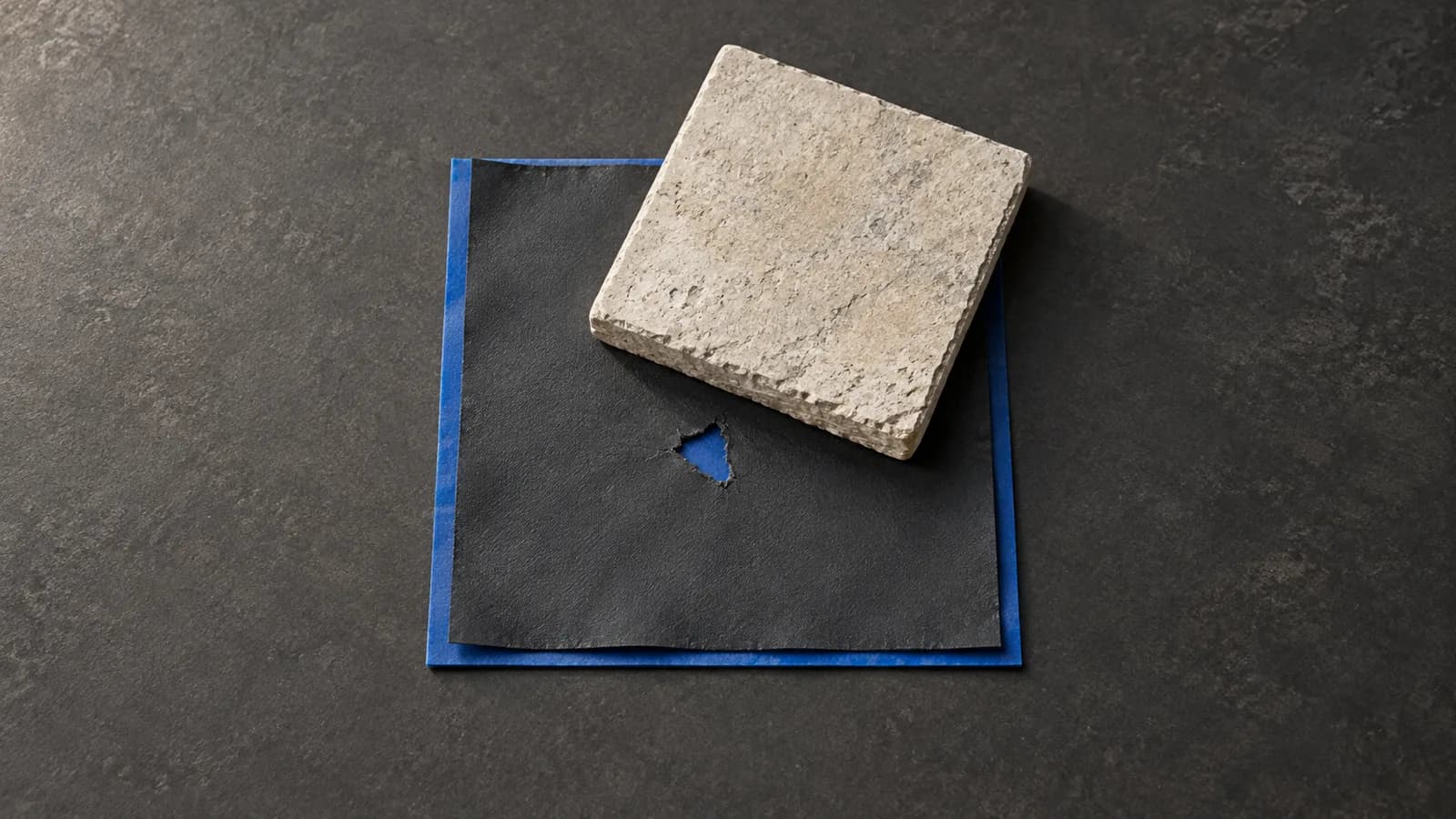
Hand over the zone plans, approved assembly, test limitations and repair history in an owner-readable format, with a retained offline copy. Contracts, applicable requirements, qualified local engineering review, manufacturer instructions and site conditions control implementation. The cover’s exposed puncture is an editorial metaphor, not an approved roof section or a testing procedure.
Sources & further reading
These primary sources support the claims and implementation frameworks used in this field note.
- 1. ASTM D7877-25 — Electronic methods for locating roofing and waterproofing membrane breaches (public scope and significance)
ASTM International
- 2. Technical Bulletin 15-8 (2015) — Electronic Leak Detection Testing Limitations
Sika Corporation — Roofing Division
- 3. ASTM D8231-24a — Low-voltage electronic membrane scanning (public scope and significance)
ASTM International
- 4. ASTM D5957-98(2021) — Flood testing horizontal waterproofing installations (public scope and significance)
ASTM International
- 5. Integrity Testing for Roofing and Waterproofing Membranes
National Institute of Building Sciences — Whole Building Design Guide
Sources checked on 20 September 2026. Numbered paragraphs summarize the cited references; the remaining paragraphs describe OlbrichCo’s proposed project-control approach, not client results. ASTM references use publicly available scope and significance statements, not the full licensed standards. Sika’s 2015 bulletin is used for physical testing limitations, not current warranty terms or a product recommendation. WBDG is technical guidance, not Iranian regulation. No test settings, universal acceptance thresholds, service-life guarantees or savings are claimed. The contract, applicable requirements, qualified local engineering review, manufacturer instructions and actual site conditions govern. Qualified specialists must select and safely execute testing. The cover is an editorial metaphor, not a construction detail.